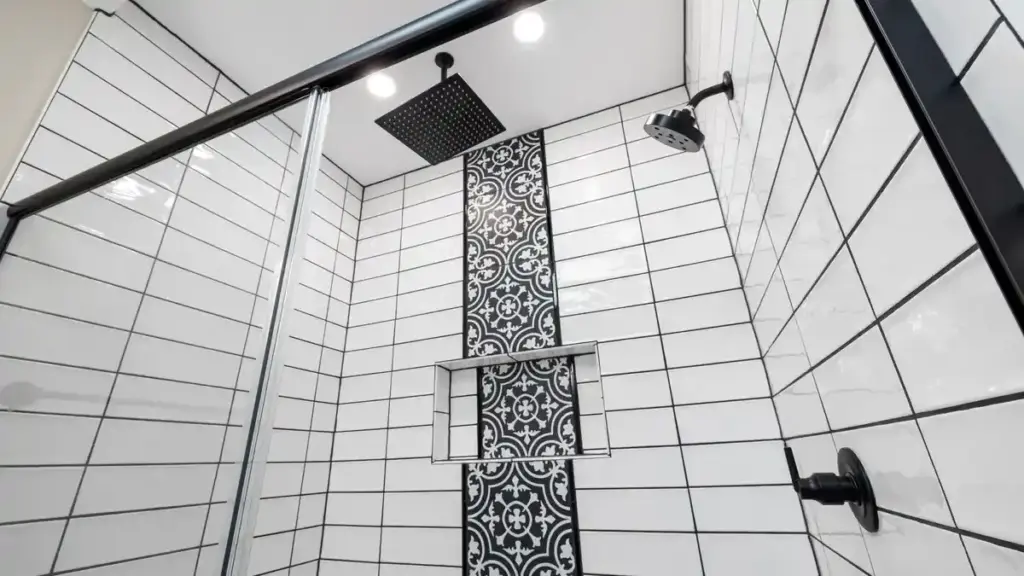
Quick answer: Shower: The Complete Guide says the right shower setup is the one that gives you enough pressure, the right temperature, and the right water use for your space. If you are trying to choose, improve, or understand a shower system, the real job is simple: match the shower type to the place it will be used and the water source it can handle.
Key takeaways
- A good shower is not one product but a setup: water source, mixing method, spray head, and drain or catch system all matter.
- The best choice for a home bath is not always the best choice for a car, campsite, or travel kit.
- Water use, pressure, and heat control are the three details that decide comfort.
- Some shower types need fixed plumbing, while others only need a jug, tank, battery, or portable pump.
- The wrong setup usually fails in one of three ways: weak flow, poor temperature control, or a cleanup mess.
What is a shower system?
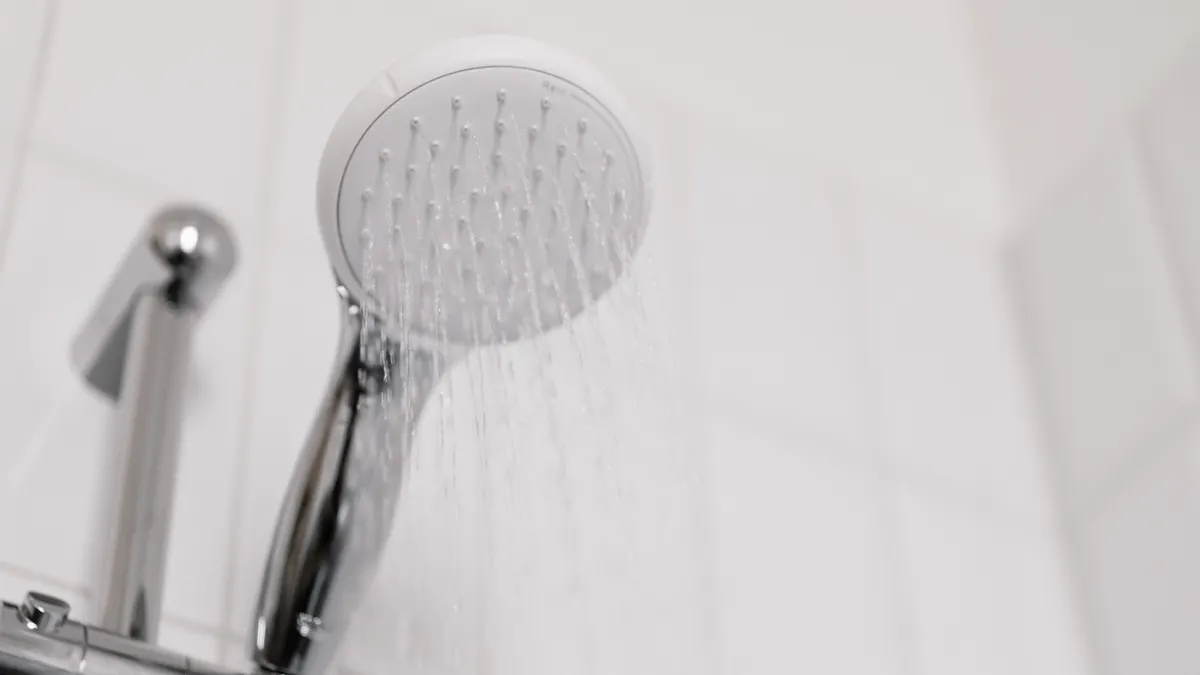
A shower system is the set of parts that makes water usable for washing, usually a water source, a way to move that water, a valve or heater, and a spray outlet. In a house, that often means plumbing, a mixing valve, a showerhead, and a drain; in a portable setup, it may be a tank, pump, hose, and handheld sprayer.
The simplest way to think about showers is by where the water comes from. Fixed home showers pull from building plumbing. Travel, car, campsite, and water jug setups rely on a container or external source. Some systems are powered, which means a pump, heater, or both; others are gravity-fed and depend on height and flow only. A standard home showerhead often mounts to a 1/2-inch pipe fitting, while portable heads may use hose fittings, quick-connect parts, or a built-in tank outlet.
A generic article often gets this wrong by treating all showers as one category. That can lead to bad advice, so it helps to check a plumbing or water-use source such as the EPA WaterSense showers page before choosing a setup. It also skips the biggest trade-off: comfort usually rises as convenience drops and cost rises. A fixed shower is easier to use every day, but a portable one can work in places with no plumbing at all.
For readers comparing options, the supporting topics matter more than a single “best” answer. Travel shower, car shower, campsite shower, mobile shower unit, potable shower, water jug shower, and powered shower are separate problems, even if they all carry the same name. A shower system is really a family of solutions, not one universal product.
How do I choose the right shower type?
You choose the right shower type by starting with the setting, the water source, and the level of convenience you need. A home bathroom, a vehicle, and a campsite have different limits, so the right answer changes fast.
Start with the location. If the shower is fixed in a home, a standard plumbing system is usually the cleanest fit. If the shower has to move with you, a mobile shower unit or portable shower makes more sense. If there is no plumbing, a jug-fed or tank-fed setup is often the simplest route. If you need shower water in a vehicle, the car shower category is the one to compare first, including options like a travel shower or a car shower.
Then match the water source to the use. Potable shower options matter when the water will be stored, handled, or sprayed close to the body for longer periods. If the source is a clean container, a water jug shower may be enough. If the source is pressurized plumbing or a dedicated tank, the choice shifts toward a powered or fixed system. A setup that depends on electricity also needs a clear plan for charging or power access. For a broader off-grid setup, see campsite shower.
| Shower type | Best for | Main upside | Main drawback |
|---|---|---|---|
| Fixed home shower | Daily bathing | Stable flow and temperature | Needs plumbing |
| Travel shower | Short trips | Small and easy to pack | Limited water capacity |
| Car shower | Vehicle use | Works away from a bathroom | Needs a water source and setup space |
| Campsite shower | Outdoor use | Fits off-grid use | Privacy and drainage can be hard |
| Mobile shower unit | Flexible placement | More complete setup | Bulkier than a simple portable kit |
| Water jug shower | Basic washdown | Simple and low cost | Limited pressure |
| Powered shower | Better flow control | Can improve weak supply | Needs power and more parts |
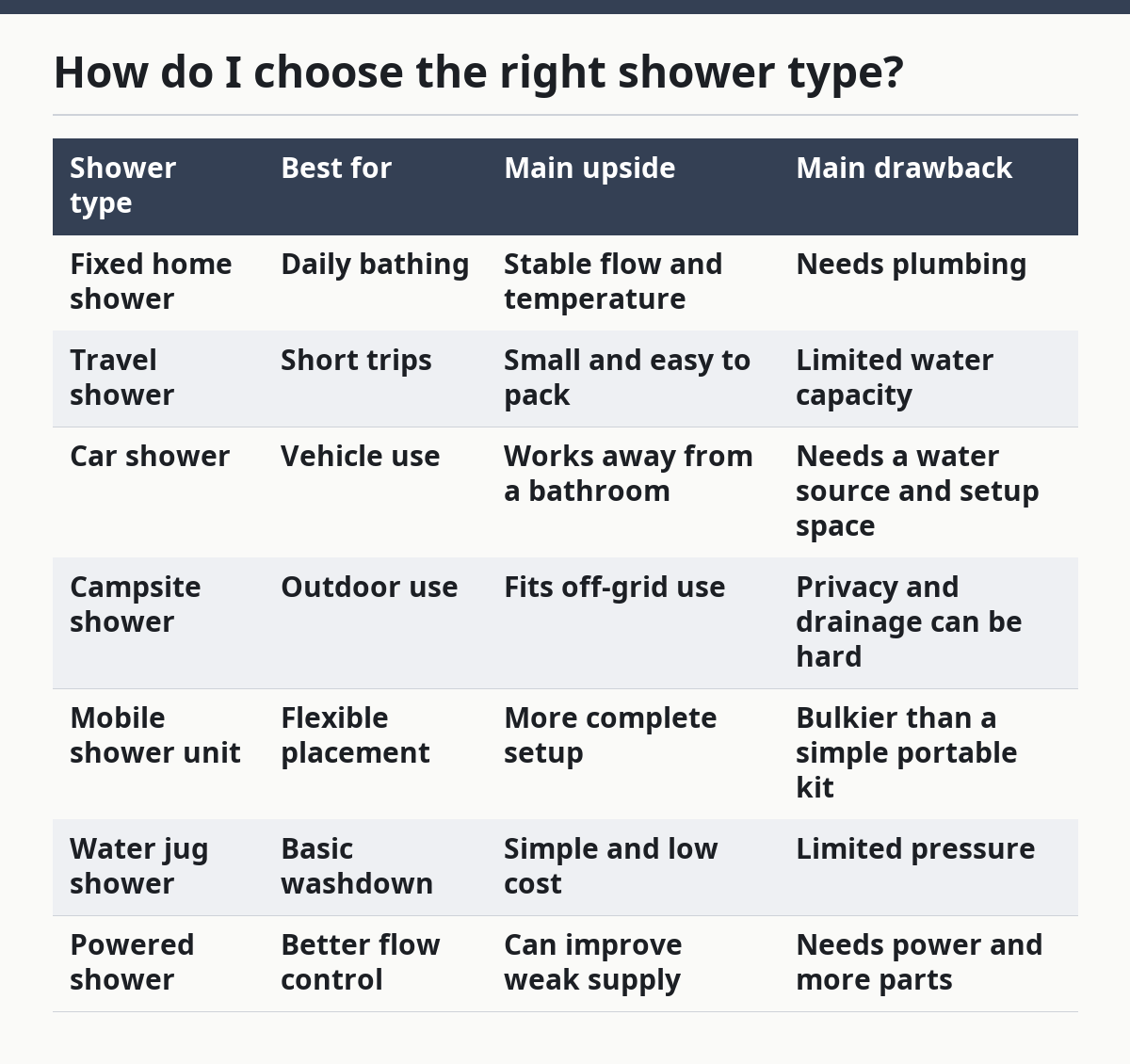
The wrong choice usually comes from buying for one feature only. A reader may want hot water and overlook drainage. Another may want portability and forget that a pump, battery, or heater adds weight and setup time. The best shower is the one that fits the day-to-day routine, not the one with the most features on paper.
What parts make a shower work?
A shower works when its parts match each other: source, pressure, temperature, spray, and drainage. Miss one of those pieces and the whole setup feels weak, even if the rest looks fine.
The water source is the first part. In a home, that is plumbing. In a portable setup, it may be a jug, tank, or container. The delivery part is next: gravity, hand pump, foot pump, battery pump, or powered unit. Then comes temperature control. A fixed shower may use a mixing valve, while a portable system may rely on preheated water or a separate heater. Finally, the spray outlet shapes the experience. A narrow spray can feel stronger, while a wider spray covers more body area.
Drainage matters more than many buyers expect. A shower that sends water onto a floor, campsite pad, or vehicle area needs a plan for runoff. Even a simple water jug shower can create a cleanup problem if the area has no slope, mat, or catch basin. In a fixed bathroom, the drain solves this. In a mobile or campsite setup, the user has to solve it. If you are planning one, it is reasonable to check local plumbing or site rules first and, when needed, ask a qualified installer.
A generic guide usually leaves out fittings and compatibility, which is where many setup problems happen. A showerhead, hose, and pump may all look close enough to fit, but thread type, hose length, and outlet shape can stop the system from working. For a reader comparing products, it helps to think in terms of a chain: if any one link is wrong, the shower is wrong.
Here is the practical order to check before buying or setting up:
- Identify the water source, such as plumbing, tank, or jug, so the rest of the system matches it.
- Check how water will move, whether by pressure, gravity, hand pump, battery, or powered pump.
- Decide how the water will feel on skin, since a mixing valve, heater, or cold-water-only setup changes comfort.
- Choose the spray outlet and hose length so the water reaches the body without awkward stretching.
- Plan where runoff will go, because a dry floor, pad, or mat can help prevent a mess after the wash, and a qualified installer can advise on site-specific drainage needs.
What is the difference between fixed and portable showers?
A fixed shower is built into a structure, while a portable shower is moved or stored when not in use. That single difference changes cost, setup time, comfort, and where the shower can be used.
A fixed shower is the better fit for a normal bathroom. It usually has the steadiest water flow, the simplest routine, and the least daily fuss. The trade-off is obvious: it depends on a plumbed space and is not meant to travel. A portable shower is the better fit for temporary use, outdoor use, or any setting without a bathroom. It can be small enough to store in a bag or large enough to act like a mobile shower unit.
The choice often comes down to how often the shower will be used. If the goal is daily washing in one place, a fixed shower saves time. If the goal is washing after travel, camping, or work in a vehicle, portable gear may be the practical choice. A portable shower can also be a bridge solution during renovations or in places where a full bathroom is not available, such as a mobile shower unit or powered shower.
The downside of portable gear is that the user takes on more work. Water has to be brought in, heated if needed, and drained safely. A fixed shower hides most of that complexity behind the walls. That is why portable showers look simple in ads but often feel more involved in real use.
The comparison below helps separate the two:
| Feature | Fixed shower | Portable shower |
|---|---|---|
| Main setting | Home bathroom | Travel, vehicle, campsite, temporary use |
| Setup effort | Low after installation | Higher each time |
| Water source | Plumbing | Jug, tank, battery, or pump |
| Comfort | Usually higher | Depends on gear and setup |
| Flexibility | Low | High |
| Best for | Daily routine | Use away from a bathroom |
Portable does not mean inferior. It means the system has to carry more of the job on its own. Fixed does not mean best. It means the building already solves part of the problem.
What mistakes should I avoid?
The most common shower mistakes are buying for the wrong setting, ignoring drainage, and assuming every water source will feel the same. Each mistake creates a different cost: wasted money, poor comfort, or a setup that is hard to use.
The first mistake is choosing by size alone. A small unit can still be wrong if it cannot match the water source or pressure. A travel shower, car shower, or campsite shower all need different inputs, even if the box says “portable.” The better test is whether the shower works with the place you actually plan to use it.
The second mistake is forgetting water temperature. A cold-only water jug shower may be fine for quick cleaning, but it is a poor fit for someone expecting a normal warm shower feel. On the other side, a powered shower can add complexity that is not worth it if the user only needs a fast rinse. Matching comfort to purpose matters more than chasing a long feature list.
The third mistake is underestimating drainage and cleanup. Water on a bathroom floor is one thing; water in a campsite, van, or storage area is another. Without a drain, tray, mat, or controlled runoff path, the shower becomes a mess after it works well for 5 minutes.
The fourth mistake is assuming “potable” and “usable” mean the same thing. Potable shower water points to water that is suitable for close human contact and storage use, but the whole system still needs clean parts and sensible handling. A bad hose, dirty tank, or poor storage plan can ruin the setup even if the source water is fine.
The final mistake is buying a powered model when a simpler setup would do. Power adds value only when it solves a real problem, such as weak pressure or a need for more control. If the user already has a practical fixed shower or a simple jug system, extra electronics may add cost without adding much comfort.
Which shower articles should I read next?
The best next article is the one that matches the place you need the shower to work. This pillar page explains the whole subject, but the real decision comes when the setting is specific, so the next step is to narrow it by use case.
A reader choosing for a trip should start with travel shower. A reader building around a vehicle should move to car shower. A reader planning an outdoor setup should go to campsite shower. A reader comparing more complete equipment should read mobile shower unit or powered shower. A reader who only needs a basic water source should check water jug shower. A reader who needs water handled as a clean, safe source should look at potable shower.
That breakdown is useful because the words sound similar while the use cases are not. A portable shower may be easy to carry but weak on pressure. A powered shower may feel better but need electricity or more hardware. A campsite shower may work off-grid yet still need a privacy plan and a runoff plan. A mobile shower unit may solve more problems at once, but it can be more than a simple user needs.
The best next step is to match the article to the problem, not the product. That keeps the search focused and prevents a person from buying gear for the wrong situation. A shower is never just a shower when the setting changes.
What is a shower best for, and what is it not for?
A shower is best for fast, controlled washing when water, space, and drainage are available. It is not the best tool for every washing task, every location, or every budget.
A shower works well when the body needs a quick rinse, a predictable spray, and a repeatable routine. In a home, that usually means the normal bathroom setup. In a portable context, it means a system that can move water from container to body without too much fuss. If the goal is a daily wash, a fixed shower usually wins. If the goal is occasional use away from plumbing, a portable system may be enough.
A shower is not the right answer when water is scarce, power is unavailable and needed, or cleanup space is tight. In those cases, a sink wash, sponge bath, or a simpler water jug setup may be more practical. It is also not the right answer if the user expects full home-shower comfort from a tiny travel kit. That mismatch is the source of most disappointment.
The honest rule is simple: the more the shower has to do on its own, the more careful the setup must be. A bathroom shower can rely on the house. A campsite or vehicle shower cannot. That is why the best shower for one person may be the wrong one for another.
What should a beginner remember first?
A beginner should remember that shower choice is about fit, not brand, size, or hype. The right setup depends on where it will be used, where the water comes from, and where the water goes after use.
If the setting is a home, start with fixed plumbing and standard shower parts. If the setting is travel, a car, a campsite, or a temporary space, start with the matching portable category and work backward from water source and drainage. If comfort matters most, look at flow and temperature control. If simplicity matters most, look for fewer parts and fewer setup steps. For general guidance on efficient water use in the home, the EPA WaterSense showerheads page and the U.S. Department of Energy water-heating guidance are useful starting points. A standard efficient showerhead can use 2.5 gallons per minute or less under federal rules, which makes water-use numbers easier to compare.
What is the easiest shower type to set up?
The easiest shower type to set up is usually the one that matches the existing space. In a home, that is a standard fixed shower because the plumbing is already there. In a temporary setting, a simple water jug shower is often the quickest because it needs fewer parts.
Is a portable shower the same as a travel shower?
No, a portable shower is broader, and a travel shower is one type of portable shower. Travel shower usually means compact gear made for packing, while portable shower can include larger kits, powered units, and mobile shower systems.
Do I need a powered shower?
No, not unless you need the extra pressure, flow control, or delivery help that power provides. A powered shower can help in weak-supply situations, but it also adds cost, weight, and more parts to maintain. If gravity or simple pressure already solves the problem, powered gear may be more than you need.
What is the biggest mistake people make with showers?
The biggest mistake is choosing the shower before deciding on the water source and drainage. That usually leads to weak flow, poor comfort, or a wet mess after use. The better order is source first, then delivery, then spray, then cleanup.
Drafted with AI; not yet reviewed by a person.
Leave a Reply