A camping shower is a portable way to rinse off away from home, usually with a bag, pump, or sprayer that holds and delivers water. Quick answer: a camping shower is usually the right choice if you want a simple rinse and can match the setup to your trip in 5 ways: water supply, privacy, weight, heat, and pressure. If you want a quick wash at a campsite, the simple answer is yes: a camping shower can work well, but only if you match the type to your water supply, privacy needs, and how much weight you want to carry.
Key takeaways
- A camping shower is not one single product. The right pick depends on heat source, water pressure, and how far you need to carry it.
- Gravity bags are the lightest option, while pump and pressurized models give better flow.
- A shower only feels good if the water is warm enough and the setup gives you enough privacy.
- Many beginners buy the wrong size, then find out the bag is too small or the pump is too weak.
- The right choice for a weekend campsite is not always the right choice for a long backpacking trip.
What is a camping shower?
A camping shower is a portable wash system that lets you spray water for a rinse, usually from a bag, tank, or bottle-sized reservoir. It is meant for camping, beach trips, trailheads, and any place where a fixed shower is not available.
The main parts are simple: a water container, a way to create flow, and a hose or nozzle. Some models use gravity alone, some use a hand pump, and some build pressure with a battery or foot pump. A basic gravity setup can weigh very little, while a pressurized unit is usually bulkier and better for car camping than for a long walk-in site.
The phrase also gets used loosely. Some people mean a hanging bag shower. Others mean a portable tent with a water source. A few mean a tank sprayer that can double as a rinse tool. That matters because the right answer changes fast if your goal is washing hair, rinsing mud, or cleaning dishes.
A camping shower is not the same as a hot-water bathroom setup. It is a field tool with limits. Water supply, temperature, and privacy all shape whether it feels useful or annoying.
Which type should you choose?
You should choose the type that matches the trip, because each style solves a different problem. The main trade-off is weight versus comfort.
| Type | Best for | Main upside | Main drawback |
|---|---|---|---|
| Gravity bag | Ultralight trips, simple rinses | Very simple, low cost, few moving parts | Weak flow, needs a place to hang it high |
| Hand-pump shower | Car camping and short stays | Better pressure than gravity | More effort to use, more parts to fail |
| Pressurized tank | Family camping or repeated use | Stronger spray and easier control | Heavier, bulkier, usually less packable |
| Solar bag | Warm-weather campsites | Can warm in the sun | Depends on weather and sunlight |
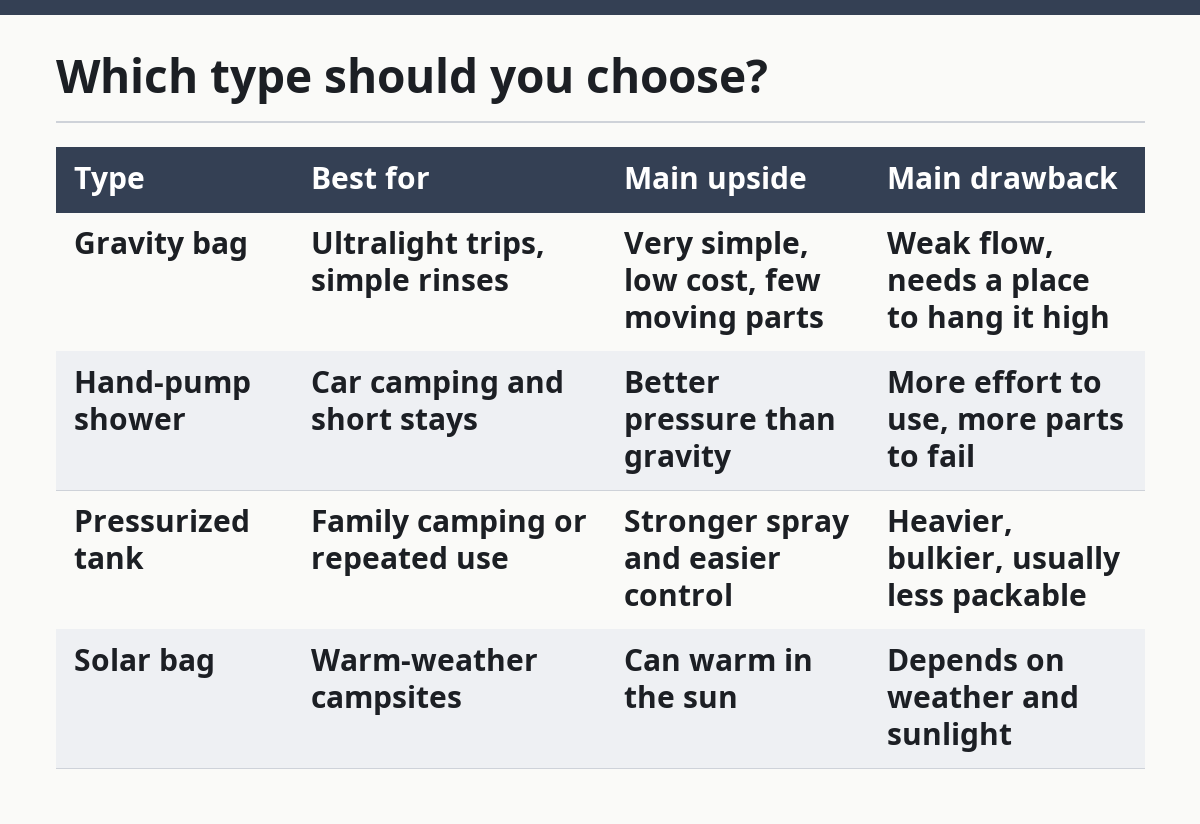
Because gravity bags rely on height and pressurized models add comfort, a gravity bag makes sense if you only need a quick rinse and want the least fuss. A pump model makes more sense if you care about steady spray and do not want to rig a high hanging point. A pressurized tank is the most comfortable of the common options, but it is the least backpack-friendly.
The wrong fit shows up fast. A tiny bag can run out before you finish your hair, and a bulky tank can be a pain to pack in a small car. If you are deciding between comfort and portability, be honest about how often you will use it. A shower you leave in the garage because it is awkward is no bargain.
How do you set up a camping shower?
You set up a camping shower by filling it, warming it if needed, hanging or pressurizing it, and testing the flow before you step in. The exact method depends on the model, but the sequence stays close to the same.
- Fill the reservoir with clean water. Use the container size your shower is built for, then leave room if the model needs air pressure. A full bag or tank is heavier than it looks, so set it on level ground before moving it.
- Warm the water only if the design allows it. Many solar bags are meant to sit in direct sun for part of the day. For other models, the maker’s instructions matter, because some plastics do not like very hot water.
- Hang or place the shower where it can drain safely. A hanging bag needs a strong branch, pole, or frame. Put it high enough to give gravity a chance to work, but not so high that the hose kinks.
- Prime the pump or build pressure. Pump models usually need a few strokes before the flow feels useful. Pressurized units need a firm seal and a stable base so the spray stays even.
- Open the nozzle and test the stream. You want a flow you can control with one hand. If the stream is weak or sputtering, the bag may be too low, the pump may need more pressure, or the hose may be twisted.
- Keep the wash short. Use wet, soap, rinse. A brief rinse uses less water and keeps the reservoir from emptying before you finish.
- Drain and dry the unit after use. Empty standing water when you are done, then let the bag or tank dry out. That helps reduce smell and makes the next setup easier.
A beginner mistake is trying to make the shower do too much. It is meant for washing, not for a long home-style shower. If you want a comfortable rinse, keep the setup simple and the sequence short.
How do you get warm water without making a mess?
Because a solar bag depends on sun exposure, warm water works best when you plan ahead instead of waiting until setup time. You can also use a stove-safe heating method approved by the maker, or a pre-mixed supply, and you keep the temperature comfortable rather than hot. Warmth is one of the biggest reasons people like camping showers, but it is also the easiest part to get wrong.
A solar bag works best in direct sun and calm weather. That can be enough for a mild rinse, but it depends on the day and the bag’s exposure. If the water is still cool at setup time, put the bag in sun earlier in the day instead of hoping it heats fast at dusk.
Do not guess with heat. Plastic containers can warp if the water is too hot, and a shower that is too warm can feel miserable in a small tent area. Lukewarm is usually the sweet spot for comfort and safety. If a model gives a temperature limit, follow it.
You also need to think about where the water goes. A camping shower can leave a slick patch of ground very quickly. Use a site that drains well, keep the nozzle aimed carefully, and do not flood a packed area. Leave No Trace guidance from the Leave No Trace Center for Outdoor Ethics and the National Park Service both stresses careful soap and water use outdoors, especially near natural water sources.
Two useful references on that point are the Leave No Trace 7 Principles and the National Park Service’s Leave No Trace guidance. Those pages are not about one brand of shower, but they are useful for how to handle water and cleanup in camp.
What mistakes make camping showers disappointing?
The biggest mistakes are buying for the wrong trip, ignoring water pressure, and assuming any shower setup will feel like a bathroom at home. Those errors usually cost comfort first, then time.
A common mistake is choosing by price alone. A cheap gravity bag can seem like a smart buy until you need stronger flow or a sturdier hang point. The cost is not just annoyance; it can mean the shower never gets used. The better move is to start with the trip type and then pick the simplest design that fits.
Another mistake is underestimating how much water you need. A small reservoir may be enough for a face rinse, but not for a full wash. If you want to clean off sand, sweat, and soap in one session, pick a capacity that leaves margin. Running dry mid-shampoo is a bad setup choice, not bad luck.
People also miss the privacy issue. A good shower system is not much use if the camp layout leaves you exposed. Some campers need a popup shower tent, a tarp, or a screened area. That is not an extra feature for many users; it is part of making the shower feel usable at all.
The last mistake is poor cleanup. Water left in the tank can smell stale, and a damp hose can collect grime. Empty the unit, dry it, and store it open if the design allows. That takes a few minutes and saves trouble next time.
Who is a camping shower not for?
A camping shower is not for someone who wants home-level pressure, unlimited hot water, or zero setup time. It is a field tool, not a bathroom in a box.
It also is not the right pick for every trip style. Backpackers who count every ounce may dislike the weight of a pressurized system. Solo travelers on short trips may not need anything beyond a water bottle, a small cloth, and a sink or stream-side rinse where allowed. On the other hand, families, beach campers, and longer car-camping trips often get more value from a full shower setup than from trying to improvise each time.
A camping shower can also be the wrong tool if your site has no safe place to drain water. If runoff would pool where people walk or reach a natural water source, a shower is the wrong choice for that spot. In that case, a sponge bath or a simpler rinse method is the better answer.
The honest test is simple: if the shower adds more hassle than comfort, you do not need a bigger shower. You need a smaller goal.
What should you check before you buy one?
You should check capacity, heat method, pressure style, hose length, and storage size before you buy one. Those five details decide almost everything you will feel at camp.
Start with capacity. A small unit may be fine for a quick rinse, but it will feel cramped if two people need it. Then look at pressure. Gravity is simplest, but pump or pressurized systems usually feel better to use. Hose length matters too, because a hose that is too short forces awkward positioning.
Storage is easy to ignore and hard to forgive later. A shower that fits in a duffel or storage bin is much easier to bring on the next trip than one that needs a large, awkward corner. If you camp from a car, size matters less than comfort. If you pack light, every inch matters.
The camping shower you keep using is usually the least complex model that still gives you the water flow and warmth you need.
Canping Shower: what’s the bottom line?
A camping shower is worth it when you want a real rinse in camp and you are willing to manage water, heat, and setup. It works best for car camping, beach trips, and longer stays where comfort matters.
The wrong choice is buying the biggest or cheapest option without thinking about your trip. If you match the shower to the job, it becomes a practical piece of camp gear. If you do not, it turns into extra weight and one more thing to clean.
What is the easiest camping shower to use?
The easiest camping shower to use is usually a gravity bag, because it has the fewest parts. You fill it, hang it high, and let water flow down with almost no setup beyond the hang point.
That said, “easy” is not the same as “best.” If the water stream is too weak or the hanging point is awkward, a pump shower may be easier in practice. The right answer depends on how much pressure you want and how much gear you are willing to carry.
Is a camping shower good for cold weather?
A camping shower can work in cold weather, but it is less pleasant and takes more planning. Warm water matters more when air temperatures drop, and a cold hose or tank can make the experience feel harsh fast.
If your trips often happen in cold conditions, choose a model that is easy to warm and simple to use quickly. A shower that depends on long sun exposure is a poor fit for that setting.
How much water do I need for one shower?
You need enough water for the kind of wash you want, not just for a quick spray. A face and hands rinse takes far less than washing hair and body, so the right reservoir size depends on your goal.
If you want one setup to handle a full wash, choose a larger container and avoid long, free-flowing rinses. Short bursts and a controlled nozzle save water and make the shower feel more useful.
Do I need a shower tent too?
You need a shower tent only if privacy matters at your campsite. Some people are comfortable with a tarp or screened corner, while others want a fully enclosed space.
A tent adds bulk, but it can make the shower much easier to use. If you already know that you will not want to stand in the open, plan for privacy from the start instead of trying to improvise later.
Drafted with AI; not yet reviewed by a person.
Leave a Reply