Quick answer: a portable shower is a movable wash system that usually works with 5 gallons or more, and it is best when it matches a specific use case such as camping, a jobsite, a van, or backup washing at home. A portable shower is a shower you can set up away from a fixed bathroom, using a tank, bag, pump, or hose instead of permanent plumbing.
Key takeaways
- A portable shower is about mobility first, not luxury.
- The right model depends on water source, power source, and how private the setup needs to be.
- Gravity bags are simple and cheap, while pump systems give stronger spray and more control.
- Water use, drainage, and heat are the three details people miss most.
- If the setup must serve a family or run every day, a fixed shower often makes more sense.
What does a portable shower include?
A portable shower usually includes a water container, a way to create pressure, a hose, and a spray head. Some versions are as simple as a 5-gallon hanging bag, while others use a 12V pump, a rechargeable battery, or a hand pump. The whole point is that the system can move, pack away, and work without a built-in shower stall.
The form factor changes a lot. A camping shower may hang from a tree and rely on gravity. A travel shower may sit in a tote and draw water from a bucket. A jobsite wash station may use a portable tank with a stronger pump and a hose long enough to reach a privacy tent.
The word “portable” matters because it describes the setup, not one exact product. That is where a lot of generic advice goes wrong. People ask about a portable shower and get answers about bathroom fixtures, while the real question is usually about water storage, pressure, heat, and where the runoff goes.
A useful way to think about it is this: a portable shower is a small system, not just a nozzle. It needs three things to work well for even a 5-minute rinse: water, flow, and somewhere safe for the water to go.
Which type should I choose?
The right portable shower depends on how often you will use it, how much water you can carry, and whether you need hot water or just a rinse. A person who wants a quick campsite wash has different needs from someone who wants an off-grid shower several days in a row.
| Type | How it works | Best for | Main trade-off |
|---|---|---|---|
| Gravity bag | Water hangs above the user and drains downward | Simple trips, light packing | Weak pressure, small capacity |
| Hand-pump sprayer | Pressure comes from manual pumping | Short washes, low-tech use | Tireing to keep pressure up |
| Battery or 12V pump | Pump pushes water through a hose | Better spray, more control | Needs power and more parts |
| Bucket-fed shower | Intake hose pulls from a bucket or tank | Camps, utility use, backup washing | Bucket must be refilled |
| Heated portable unit | Water is warmed before use or mixed with hot water | Colder weather, more comfort | Heavier, more complexity |
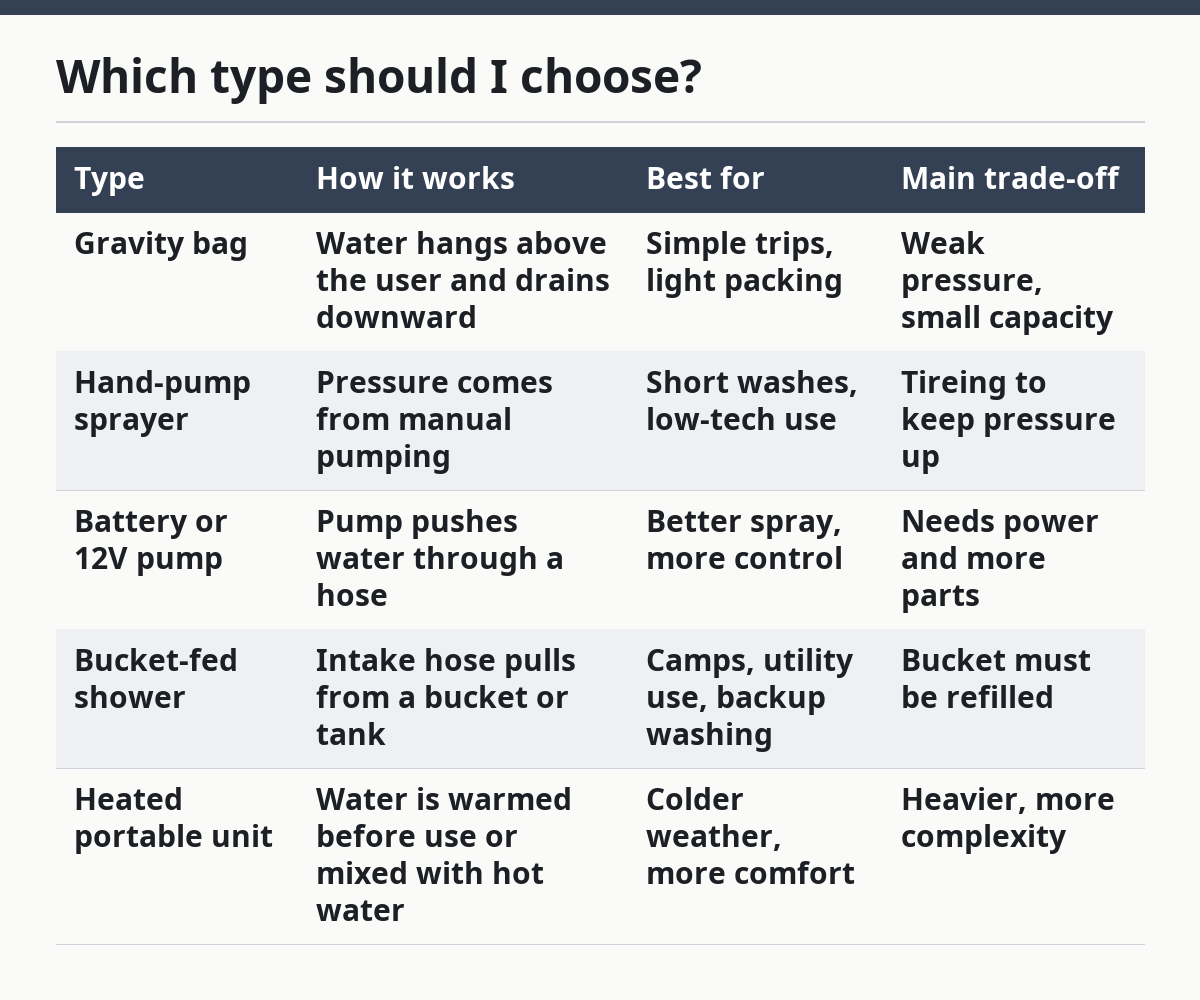
If the goal is the lightest possible kit, a gravity bag is hard to beat. If the goal is a better shower feel, a pump system is usually the better pick. If the goal is a reliable wash station for more than one person, a unit with a tank and pump is often the practical choice.
A generic article often misses the mismatch between “portable” and “comfortable.” A cheap hanging bag may count as a portable shower, but it can feel weak and uneven. A pump system may cost more in money and setup time, but it can feel far closer to a real shower.
The wrong choice is easy to spot. If you need hot water, steady pressure, and a curtain or stall, a bare gravity bag will frustrate you. If you only need a quick rinse after a dusty hike, a powered unit may be more than you need.
How do I set up a portable shower?
You set up a portable shower by choosing a flat spot, filling the water source, connecting the hose or head, checking drainage, and testing the flow before you strip down. A clean setup usually takes only a few minutes once the parts are sorted, but the order matters.
- Pick the location first. Set the shower where water can drain away from tents, gear, or flooring. A flat patch with enough room for a privacy tent is better than a tight corner where runoff pools.
- Place the water source at the right height or position. A gravity bag needs to hang high enough for the water to flow. A pump system can sit on the ground beside the bucket or tank.
- Connect the hose and shower head. Make sure the fittings are tight enough that the hose does not slip off when pressure starts. A loose connection can waste water fast.
- Add water at the right temperature. Fill with the amount the system is meant to handle, and avoid overfilling a bag that is not built for it. Warm water is often mixed before it goes in.
- Prime or switch on the pump. For a battery or 12V setup, start the pump and let water run through for a few seconds. The spray should be steady, not sputtering.
- Test the runoff. Run water for 30 to 60 seconds and watch where it goes. If it pools underfoot, move the setup or add drainage before using it for real.
- Shower with the flow under control. Turn water off while soaping when the system allows it. Portable showers work best when water use stays tight.
- Drain, dry, and pack it. Empty the tank or bag after use, then let hoses and nozzles dry. That helps prevent smell and grime.
The biggest mistake is setting up first and thinking about drainage later. A portable shower can work fine for 5 minutes and still create a mess if the ground stays soggy. The second common mistake is skipping the flow test, then finding out the pump is weak or the hose leaks after clothing is off.
For water-saving habits, the EPA’s WaterSense showerhead guidance is a useful reference point, even though a portable shower is not the same as a fixed bath fixture. The U.S. Department of Energy also has a guide to low-flow showerheads, which helps frame why flow control matters in any shower system.
What do people get wrong with portable showers?
People get the water source right and the rest wrong, which turns a simple wash into a leaky or miserable setup. The usual misses are pressure, privacy, heat, and drainage, and each one has a cost.
A shower that sprays too softly wastes time and still leaves soap behind. A shower that sprays too hard can burn through a small water tank in a hurry. A setup with no privacy screen may be fine at a remote campsite and terrible in a shared yard or work area.
Another common mistake is assuming a bigger tank solves everything. A larger container helps with runtime, but it also adds weight, takes longer to heat, and is harder to move. For a single user, a smaller system may be smarter than a heavy one that stays half-full.
Here is the trade-off in plain terms:
| Mistake | What it costs | Better choice |
|---|---|---|
| Choosing only by tank size | Heavy carry, slower heating, awkward storage | Match tank size to the number of users |
| Ignoring drainage | Mud, puddles, slippery ground | Place the shower where runoff can move away |
| Using weak pressure for soap-heavy washing | Longer rinse time, more water use | Pick a pump or head with steadier flow |
| Forgetting privacy | Awkward use in shared spaces | Add a tent, screen, or enclosed stall |
| Skipping dry-down after use | Odor, buildup, shorter hose life | Empty and air-dry parts after each session |
A portable shower is also not the right answer for every home problem. If you need daily bathing for a household, or a permanent bathroom in a remodel, a portable setup is a stopgap, not a full substitute. It can cover a gap, a trip, or an emergency. It is not meant to replace plumbing forever.
How do I choose the right one for camping, travel, or backup use?
You choose the right portable shower by matching the system to the setting, the water source, and the amount of comfort you need. Camping favors light weight and simple setup, travel favors compact storage, and backup use at home favors reliability and easy refilling.
For camping, a gravity bag or small pump unit is usually enough if you only need a rinse. For van or RV use, a pump system with a hose and a more contained water source is often easier to live with. For emergency backup use, a system that stores water safely and can run without mains power is the safer practical choice.
A good filter is how much handling you want. Some portable showers need you to fill a bag, hang it, warm it, and manage the flow by hand. Others let you drop a hose into a bucket and get moving in under a minute. If the user wants the least fuss, the second style is usually easier.
Use this rough guide:
- Light pack, short trip: gravity bag or hand-pump sprayer
- Regular camping or van use: battery or 12V pump
- Shared use or backup washing: larger tank with a pump
- Minimal storage space: compact hose-and-head kit
- Best shower feel: a pump system with steady pressure
The wrong choice for this section is the one that looks nice in a listing but does not fit the daily routine. A setup that needs 10 steps before the first spray will end up unused, even if the specs look good. Simplicity matters more than extras when the whole point is portable use.
How do I keep it clean and working?
You keep a portable shower working by emptying it after use, rinsing the hose and head, and letting every wet part dry fully before storage. That is the habit that protects the pump, the bag, and the hose from odor and buildup.
Soap residue is the main problem. It collects in nozzles and hoses, then causes weak spray or sticky parts later. If the system uses a pump, stale water left inside is even worse. A 1-minute rinse is often enough after each use, but the parts still need time to dry.
Storage matters too. Keep sharp folds out of hoses when possible, and avoid crushing fittings under heavy gear. If the shower uses a battery or electric pump, store the power parts dry and separate from the wet parts. That reduces the chance of damage the next time it comes out.
This is the section where a lot of generic advice says “just keep it clean,” which means nothing. A better rule is simple: drain it, rinse it, air it out, and store it in a way that does not kink the hose. Those four steps prevent most of the annoyance people blame on the product itself.
What is the short answer for a first-time buyer?
A portable shower is a movable wash system, and a good one is often the simplest model that still gives you enough pressure, privacy, and drainage for the way you will actually use it. A gravity bag is enough for basic rinsing, while a pump setup is better when comfort matters.
The right choice is not always the most powerful one, because more power can mean more weight, more parts, and more cleanup. A 12V pump, a bucket-fed intake, or a hanging bag each solves a different problem. If the use is occasional, small, and outdoors, keep the system simple. If the use is repeated or shared, choose the model that handles water flow and cleanup with less effort.
The cleanest decision rule is this: pick the smallest system that can finish the job without frustration. Anything larger should earn its place by solving a real problem, not by sounding more impressive on a product page.
What is a portable shower, in one sentence?
A portable shower is a movable shower setup that uses a bag, tank, or pump instead of permanent plumbing. It is built for places where a fixed bathroom is not available or not practical.
Is a portable shower the same as a camping shower?
Yes, a camping shower is one common type of portable shower. “Portable shower” is the broader term, and it also covers travel, van, jobsite, and backup wash systems.
Do portable showers need electricity?
No, not all of them do. Gravity bags and hand-pump sprayers work without electricity, while pump-based models may use a battery or 12V power source.
Can a portable shower be used indoors?
Sometimes, but only if the drainage and ventilation are handled properly. A portable shower used indoors can create water damage fast if the runoff has nowhere to go, so the setup needs careful planning.
Drafted with AI; not yet reviewed by a person.
Leave a Reply