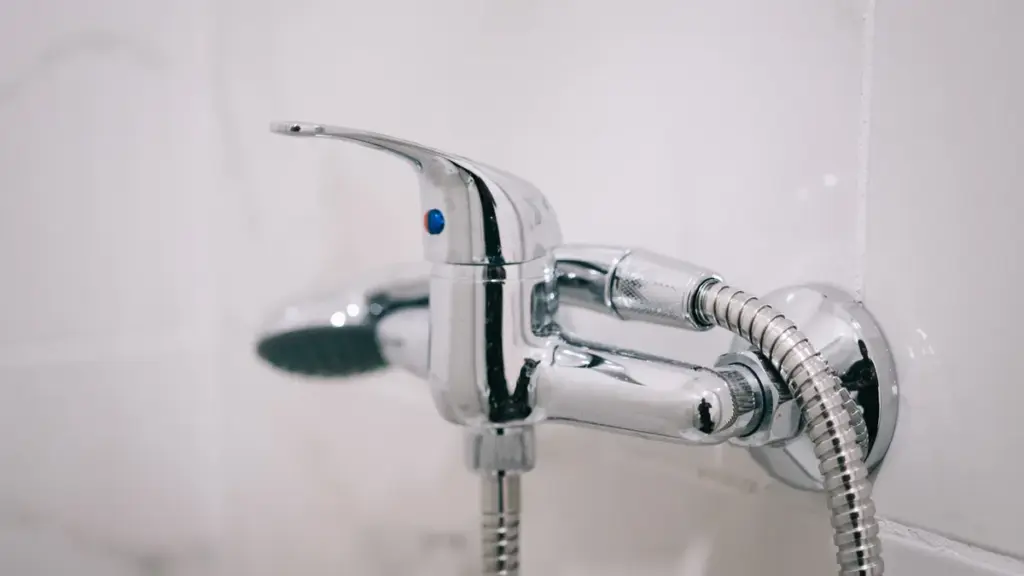
Key Takeaways
- A battery operated shower head runs a powered feature with a battery, not the water supply.
- It fits best when you want a powered shower feature without an outlet near the shower.
- Check the manual or old battery for the exact replacement size.
- Replace the battery by opening the compartment, swapping in the right size, and closing it securely.
Quick Answer: A battery operated shower head is a shower head with 1 battery-powered feature inside it, and the battery size is the first thing to check before you buy or replace anything. If you want easier control, a powered feature, or a shower setup that does not depend on a wall outlet, this type can fit the job, but it is not the right pick for every bathroom.

What does a battery operated shower head do?

A battery operated shower head uses a battery as its power source, and a battery is a device that provides electrical power, according to Wikipedia. That power is usually used for a built-in feature inside the shower head rather than for the water itself.
Because the battery only supports the shower head’s powered function, the important part is the split between water flow and electrical power. A battery is made of one or more voltaic cells, and each half-cell has an electromotive force measured in volts relative to a standard, according to Wikipedia. In plain terms, the battery is there to make a small part of the shower head work on its own.
That matters because a shower head is not the same thing as a pump. The shower still depends on the plumbing in the wall for water. The battery only supports the shower head’s powered function, so the setup can still be limited by water pressure, hose length, and how the head is mounted.
A good way to think about it is this: the battery is the power source, not the water source. If someone expects the battery to “create” stronger water flow on its own, that expectation is off. The battery can support a function, but it does not replace the plumbing.
This is also why people often ask about replacement batteries before they buy one. Battery sizes are not all the same. Common battery sizes include AA, AAA, C, D, and 9 volt, plus AAAA, 6-volt lantern-style, and 28A batteries, according to Batteries Plus. The exact battery size depends on the shower head design.
Is a battery operated shower head right for you?
A battery operated shower head is right for you if you want a powered shower feature and you prefer a setup that does not need an outlet near the shower. It is not right for you if you want a simple, no-maintenance shower head with nothing to replace.
The main trade-off is upkeep. A battery-powered feature needs battery changes, while a plain shower head does not. That means there is one more thing to think about over time, even if the rest of the bathroom setup stays the same.
Another trade-off is fit. A battery operated shower head is still just one part of a larger shower system, so it has to work with the rest of the hardware. If you already have a shower head that meets your needs, adding a powered model may solve one problem and create another, such as more upkeep or a more complex install.
This is where the battery type matters. Batteries Plus says its alkaline batteries have about a two-year shelf life and retain about 90% of their power when unused. That does not mean every shower head battery will last that long in use, but it does show why shelf life matters if you keep spares on hand.
A battery operated shower head is also a poor fit for anyone who wants zero fuss. If you want to install it and forget about it for years, a battery-powered model is the wrong category to look at. The battery makes it useful, but it also creates a maintenance cycle.
Which battery size should I look for?
You should look for the battery size named in the shower head manual or on the old battery itself. Common battery sizes include AA, AAA, C, D, and 9 volt, plus AAAA, 6-volt lantern-style, and 28A batteries, according to Batteries Plus.
That list matters because a battery compartment is built for a specific size. A 9 volt battery does not fit where an AA battery belongs, even though both are standard household batteries. The shape, contact points, and fit all have to match.
If the battery model number is not obvious, search by model number or brand name to find a replacement battery, according to Batteries Plus. That is useful when the compartment label is worn or the original battery wrapper is gone.
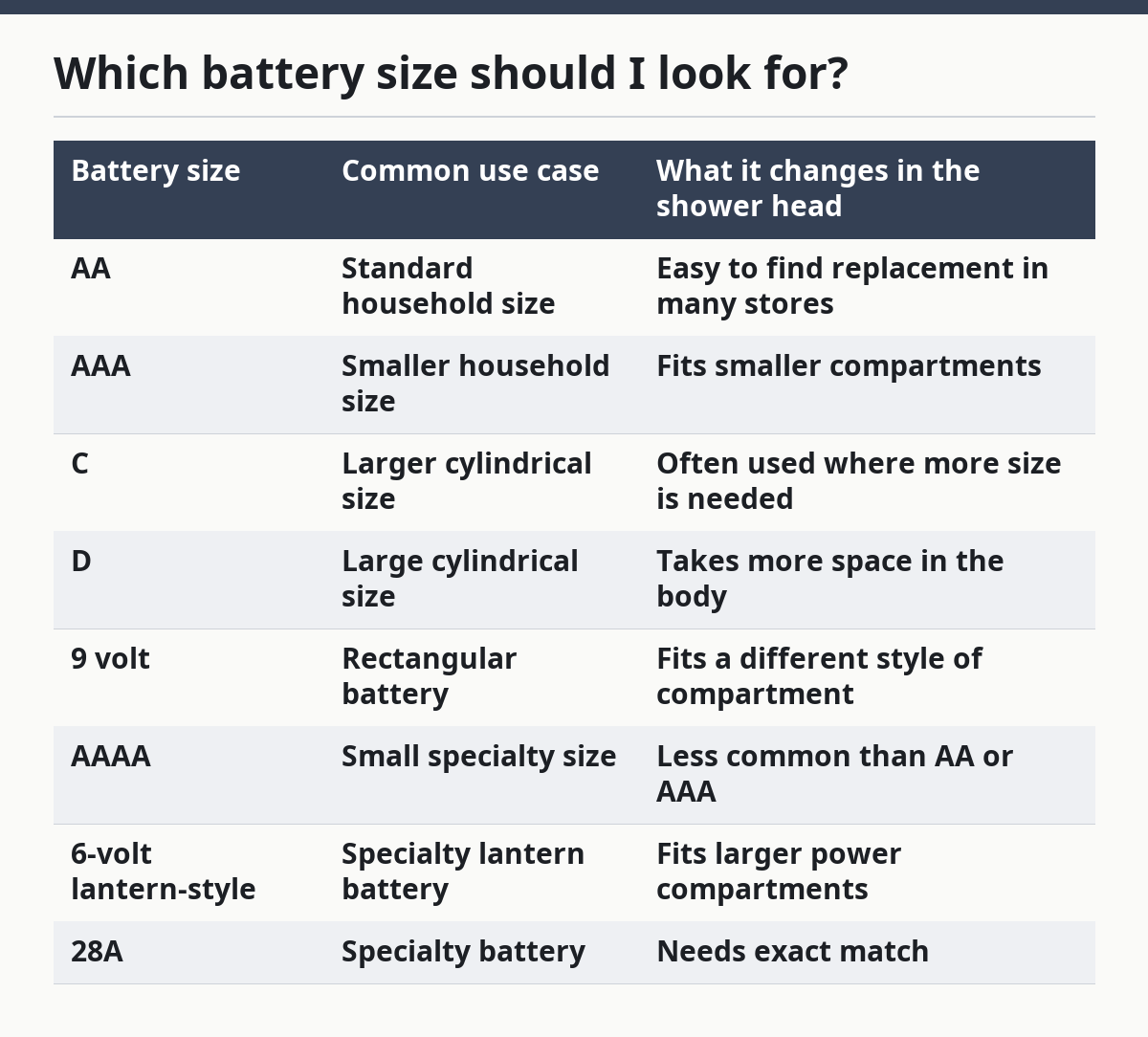
Here is the practical comparison a buyer usually needs:
| Battery size | Common use case | What it changes in the shower head |
|---|---|---|
| AA | Standard household size | Easy to find replacement in many stores |
| AAA | Smaller household size | Fits smaller compartments |
| C | Larger cylindrical size | Often used where more size is needed |
| D | Large cylindrical size | Takes more space in the body |
| 9 volt | Rectangular battery | Fits a different style of compartment |
| AAAA | Small specialty size | Less common than AA or AAA |
| 6-volt lantern-style | Specialty lantern battery | Fits larger power compartments |
| 28A | Specialty battery | Needs exact match |
The most common mistake here is guessing. A battery that is “close enough” is not enough. If the shower head calls for one size and you buy another, the compartment will not close or the contacts will not meet properly.
How do I replace the battery?
You replace the battery by opening the battery compartment, removing the old battery, inserting the correct replacement, and closing the compartment securely. The process is simple, but the fit has to be exact.
- Find the battery compartment. It is usually on the shower head body or on a small attached module, and the label often names the battery size.
- Read the battery size before you remove the old one. Look for AA, AAA, C, D, 9 volt, AAAA, 6-volt lantern-style, or 28A, because the compartment only takes the exact match.
- Remove the old battery. Take it out carefully so the contacts stay clean and the compartment stays dry.
- Insert the replacement battery in the same direction. The battery should sit flat and line up with the contact points, not sit at an angle.
- Close the compartment firmly. The cover should shut without force, which tells you the battery is seated correctly.
If the shower head does not turn on after that, the first thing to check is the battery size and orientation. The second is whether the compartment is fully closed. A partially closed cover can stop the powered feature from working even when the battery is new.
Because the battery shelf life can help, Batteries Plus says alkaline batteries have about a two-year shelf life and retain about 90% of their power when unused. Keeping a spare battery in the right size can save a lot of hassle later, especially if the shower head uses a less common format. If the compartment is sealed, damaged, or hard to reach, consult the product manual or a qualified professional before forcing it open.
What are the most common mistakes?
The most common mistakes are using the wrong battery size, forgetting that the battery is only part of the system, and expecting the shower head to behave like a pump. Each mistake costs time, and the fix is usually simple once the cause is clear.
Using the wrong size is the easiest way to waste a battery. A battery that does not match the compartment may not fit, or it may make weak or no contact. The fix is to match the shower head to one of the known battery sizes, such as AA or AAA, or to search by model number or brand name for the correct replacement, according to Batteries Plus.
Another mistake is treating the battery as if it controls water pressure. It does not. The battery provides electrical power, according to Wikipedia, while the plumbing still supplies the water. If the shower flow is weak, the problem may sit outside the battery compartment, so consult a plumber or the product manual if the issue is unclear.
A third mistake is buying random spares and storing them without checking the size. A battery drawer full of mixed cells does not help much if the shower head needs one exact format. Shelf life helps, but only if the battery is the right one in the first place.
This is also why a battery operated shower head is not ideal for someone who wants the least possible upkeep. A plain shower head is simpler. The battery-powered version adds convenience for one feature, while also adding a replacement task that can show up at the worst time.
When should you avoid this kind of shower head?
You should avoid a battery operated shower head if you want a low-maintenance setup, if you dislike replacing batteries, or if you do not want to keep track of exact battery sizes. It is the wrong choice for someone who values simplicity over powered features.
It is also a poor fit if the battery compartment is hard to reach or the replacement battery is a less common size. The more obscure the battery, the more likely it is that a simple swap turns into a search. Batteries Plus notes that you can search by model number or brand name to find a replacement battery, which helps, but it still adds a step.
The cleanest reason to skip it is this: if the powered feature is not something you truly need, the battery only adds upkeep. A regular shower head avoids that issue completely.
There is also a practical limit in any bathroom: the shower head still depends on the plumbing and the installation it connects to. The battery cannot fix a poor water setup. It only powers the feature inside the shower head.
What should I check before buying one?
You should check the battery type, the compartment access, and whether the model or brand has a clear replacement path. Those three details matter more than the words on the box.
Start with the battery size. If the product uses one of the common sizes—AA, AAA, C, D, or 9 volt—you have an easier time finding replacements. If it uses AAAA, 6-volt lantern-style, or 28A, make sure you are ready to track that exact size down.
Then check how you will replace it. If the battery compartment is awkward to open, even a simple battery change can become a nuisance. A battery operated shower head only stays useful when the replacement process is easy enough to repeat.
Finally, look for clear model or brand information. Batteries Plus says you can search by model number or brand name to find a replacement battery. That is the kind of detail that keeps a maintenance item from becoming a dead-end purchase.
A good purchase decision here is not about choosing the most complex shower head. It is about choosing the one whose battery size, access, and replacement path make sense for your bathroom and your tolerance for upkeep.
FAQ
What is a battery operated shower head, really?
A battery operated shower head is a shower head with a battery-powered feature inside it. The battery provides electrical power, while the plumbing still provides the water.
Do all battery operated shower heads use the same battery?
No, they do not all use the same battery. Common battery sizes include AA, AAA, C, D, and 9 volt, plus AAAA, 6-volt lantern-style, and 28A batteries, according to Batteries Plus.
How do I find the right replacement battery?
Search by model number or brand name if the battery size is not obvious. Batteries Plus says that method helps locate a replacement battery when the exact match is needed.
How long do alkaline batteries last on the shelf?
Batteries Plus says alkaline batteries have about a two-year shelf life and retain about 90% of their power when unused. That makes them a practical spare, as long as you buy the correct size.
Is a battery operated shower head the same as a power shower?
No, it is not the same thing. The battery provides electrical power for a feature in the shower head, but it does not replace the plumbing or turn the head into a pump on its own.
Sources
- Wikipedia, Battery – Wikipedia (checked 18 Nov 2026)
- Batteries Plus, Battery at Batteries Plus (checked 18 Nov 2026)
- Wikipedia, Electric battery – Wikipedia (checked 18 Nov 2026)
Drafted with AI; not yet reviewed by a person.
Leave a Reply