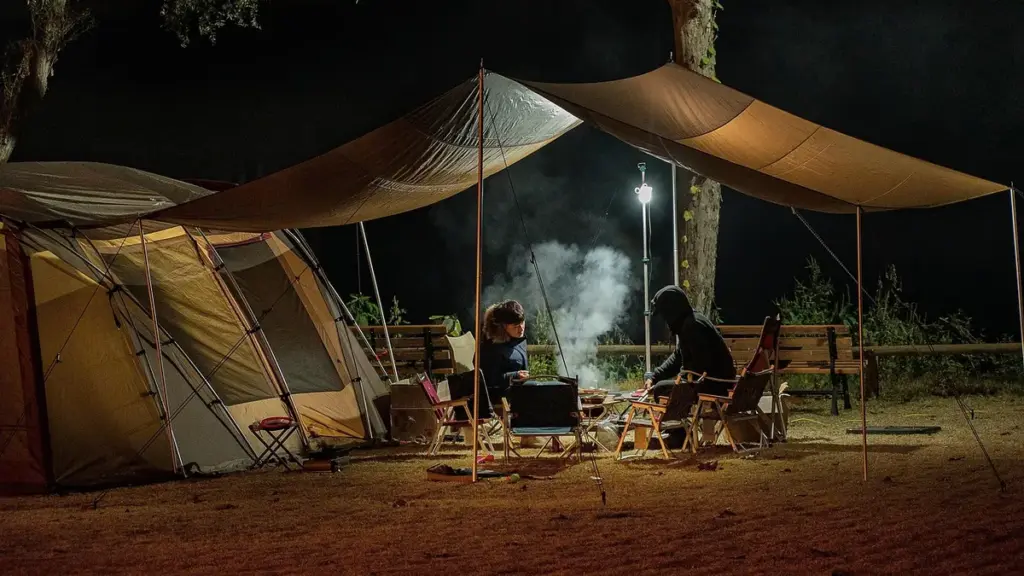
It depends entirely on where you are. National parks, state parks, private campgrounds and dispersed public land each set their own rules, and no single federal law makes outdoor showering legal or illegal everywhere. The two things almost every site agrees on: keep used water out of lakes and streams, and stay screened from other people.
Key takeaways
- There is no one national answer. Rules on nudity, screening and wastewater disposal vary by land type and by the specific park, campground or agency.
- National parks set their own backcountry rules; some, like Canyonlands, ban camping within a set distance of water sources, which affects where you can set up and drain a shower.
- Some state parks regulate nudity directly (North Carolina bans public nude bathing), and some regulate wastewater directly (California bans dumping it on the ground).
- Private campgrounds answer to their own owner, not a government agency — always check the posted rules or ask at check-in.
- On dispersed BLM or national forest land, federal rule allows wash water disposal from a vehicle but sets no specific distance; Leave No Trace’s 200-foot distance is a practice recommendation, not that regulation’s actual text.
Why isn’t there one simple answer?
A portable camp shower touches two separate legal questions: is it okay to be unclothed outdoors, and is it okay to pour used water on the ground or into a waterway? Different agencies and landowners answer each question differently, and some address only one of the two.
National parks, state parks, private campgrounds and dispersed public land (BLM or national forest) each operate under a different rulebook. A rule that applies at one state park doesn’t automatically apply at the national forest ten miles away, or at the private RV park next door. The only honest answer is to check the specific rules for wherever you’re actually camping.
What’s the rule on national park and NPS backcountry land?
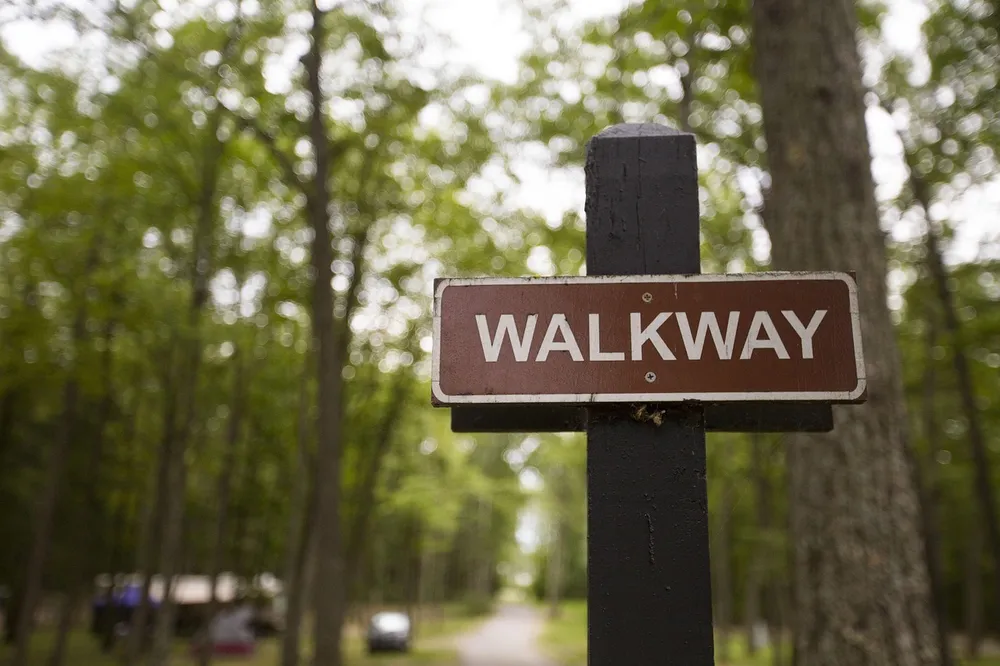
National parks set backcountry regulations park by park, and those regulations often focus on protecting water sources rather than regulating showers directly. At Canyonlands National Park, for example, the National Park Service prohibits camping within 300 feet of a water source, and restricts bathing and swimming to designated rivers. That 300-foot figure is specific to Canyonlands; a different park can set a different distance or none at all.
The practical effect for a portable shower is the same either way: if you can’t camp or bathe within a set distance of a water source, you can’t set up and drain a camp shower there either. Always read the specific park’s backcountry regulations page before a trip, since the National Park Service doesn’t publish one blanket nationwide rule for every park.
What do state parks actually regulate?
State parks are a patchwork, not a pattern. Here’s what three specific states regulate, based directly on their own published rules — this is not a 50-state survey, so don’t assume your state matches any of these.
- North Carolina: NC State Parks rules prohibit public nudity, including public nude bathing, with an exception only for children under 5.
- California: California State Parks’ general provisions (Rule 4322) prohibit nudity except in areas the Department has specifically authorized, and a separate rule (Rule 4324) prohibits depositing wastewater, sewage or effluent directly on the ground or into water.
- Colorado: Colorado’s sanitation code (6 CCR 1010-14.0 §14.12), which covers public bathing facilities broadly rather than campgrounds specifically, requires that “each toilet and bathtub or shower shall be individually partitioned with self-closing doors… except that showers may be equipped with a waterproof draw curtain.” That’s evidence that screening showers is a real regulatory norm in at least one state, even though it isn’t written as a campground-specific shower-tent law.
Notice that North Carolina’s rule is about nudity, California’s pair of rules covers both nudity and wastewater separately, and Colorado’s is about screening. None of the three states regulates exactly the same thing, which is the whole point: read your specific state park’s own posted rules rather than assuming any of these apply where you’re going.
What about private campgrounds?
A private campground isn’t bound by a state park’s regulations or a national park’s backcountry rules. Its rules come from the owner or operator, and they can be stricter or looser than any government rule covered above. Many private campgrounds are fine with an outdoor shower as long as it’s screened from other guests and doesn’t drain into a shared water source or septic field. Some ban outdoor bathing outright, especially in tightly packed RV parks.
The only way to know is to check the campground’s posted rules, its website, or ask at check-in before you set anything up. If you plan to use a pop-up shower tent, this is also the moment to confirm there’s room for one at your specific site — see how to set up a privacy shower tent when there are no trees for options that work on a compact campsite pad.
What’s the rule on dispersed BLM or national forest land?
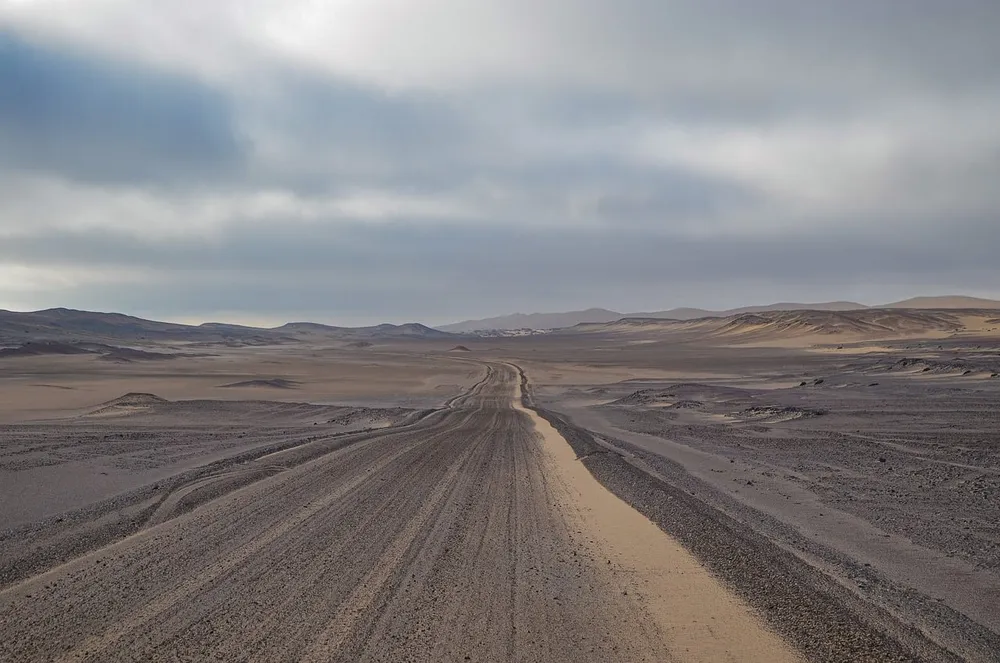
Dispersed camping on Bureau of Land Management (BLM) or U.S. Forest Service land has no campground office to ask, so the actual rule is federal regulation. 43 CFR § 8365.1-1, the BLM’s public-land rule of conduct on sanitation, prohibits draining sewage or dumping refuse from a vehicle — but it specifically exempts wash water, and it does not set a distance requirement for where that wash water can go.
That’s an important distinction: Leave No Trace’s commonly cited guidance of roughly 200 feet from water, trails and campsites is a practice recommendation, not the wording of this federal regulation. Treat the 200-foot figure as responsible practice, and treat 43 CFR § 8365.1-1 as the actual legal text, since the two aren’t the same source and shouldn’t be quoted as if they were. For the full checklist on handling that water once you’re set up, see how to dispose of camp shower gray water the right way.
Outdoor shower rules by land type
Here’s the comparison, with the near-universal practical pattern underneath it.
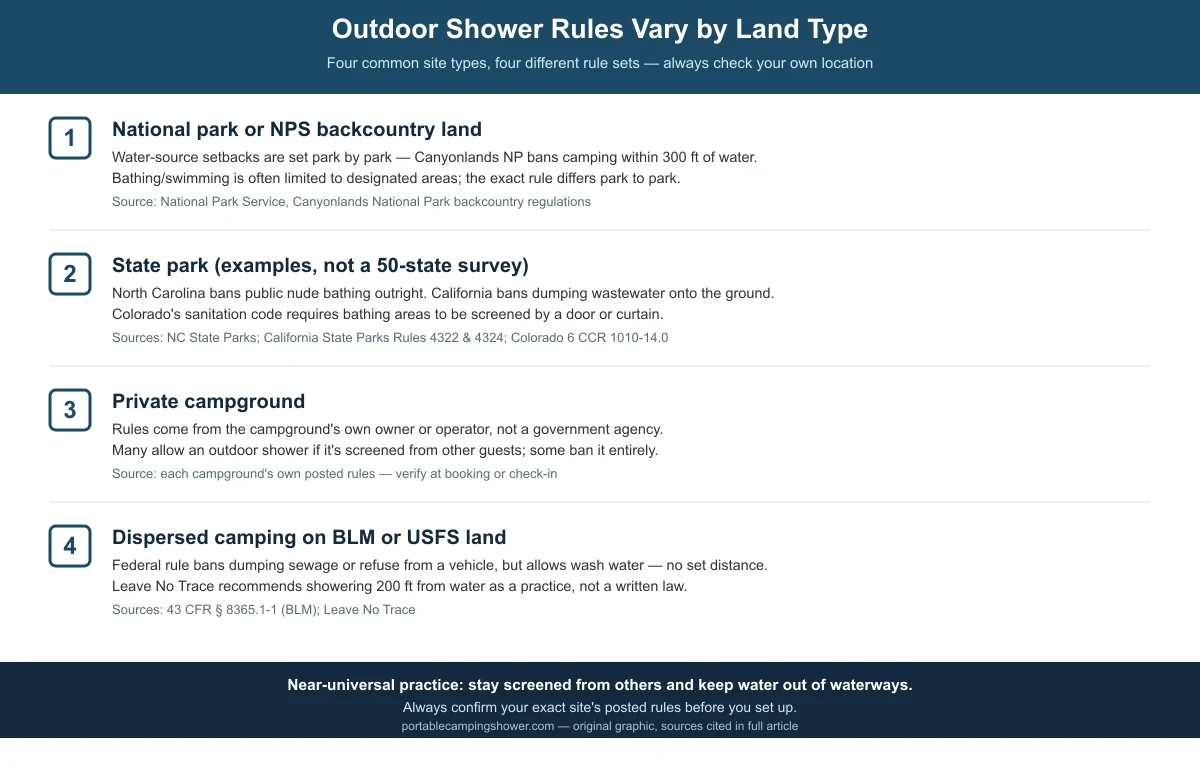
| Land type | What’s actually regulated | Source |
|---|---|---|
| National park / NPS backcountry | Water-source setback (distance varies by park, e.g. 300 ft at Canyonlands); bathing often limited to designated areas | National Park Service, park-specific backcountry regulations |
| State park (NC example) | Public nude bathing prohibited | NC State Parks rules |
| State park (CA example) | Nudity prohibited except in designated areas; wastewater/effluent may not go on the ground or into water | California State Parks Rules 4322 & 4324 |
| State sanitation code (CO example) | Bathing facilities must be screened by a self-closing door or a waterproof curtain | Colorado 6 CCR 1010-14.0 §14.12 |
| Private campground | Set entirely by the owner/operator — no fixed rule | Each campground’s own posted rules |
| Dispersed BLM/USFS land | No sewage/refuse dumping from a vehicle, but wash water is exempt; no set distance in the regulation itself | 43 CFR § 8365.1-1; Leave No Trace practice guidance for distance |
Across all of these, two things show up again and again, even though no single law states them as one combined national rule: keep used water from running into a waterway, and stay screened from other people. Those two habits will keep you inside the spirit of almost every rule above, but they don’t substitute for checking the specific rule where you’re actually camping.
How do you find the actual rule for your specific trip?
Before you set up a portable shower, do three quick checks:
- For a national or state park, search “[park name] backcountry regulations” or check the park’s own rules page for anything about bathing, nudity or wastewater.
- For a private campground, check its website’s rules page or ask at check-in.
- For dispersed BLM or national forest land, assume Leave No Trace’s screening and distance practices apply, since there’s no on-site rules board to check, and follow the disposal checklist in how to dispose of camp shower gray water the right way.
Once you know the rule for your site, the actual setup — privacy, hanging or mounting the unit, filling it, and draining it — follows the same sequence everywhere. See how to set up a portable camping shower, step by step for that full walkthrough.
Frequently asked questions
Is it legal to shower naked outside at a campsite?
It depends entirely on the specific site. Some state parks prohibit public nudity outright (North Carolina) or restrict it to designated areas (California); a private campground sets its own rule; dispersed public land has no on-site rule at all beyond general screening practice. There’s no single answer that covers every location.
Can I dump my camp shower’s water on the ground?
Sometimes, but not always, and never directly into a lake or stream. California’s state park rules specifically prohibit depositing wastewater on the ground or into water. Federal BLM regulation allows wash water disposal from a vehicle without a stated distance, while Leave No Trace recommends doing it well away from water and campsites as a practice. Check your specific site’s rule first.
Do I need a privacy tent to use a camp shower legally?
Not always, but it’s a reasonable precaution almost everywhere. Colorado’s sanitation code requires bathing facilities to be screened by a door or curtain, and staying out of view of other campers is one of the few near-universal practices across land types, even where it isn’t written into law.
What’s the difference between a national park rule and a Leave No Trace recommendation?
A national park’s backcountry regulation (like Canyonlands’ 300-foot water setback) is an enforceable rule specific to that park. Leave No Trace’s 200-foot distance guidance is a widely used practice recommendation, not a law, and it doesn’t automatically match any specific park’s or agency’s actual regulation. Don’t treat the two as interchangeable.
Who do I ask if I can’t find a posted rule?
For a national or state park, contact the park office or check its official regulations page. For a private campground, ask the owner or front desk. For dispersed BLM or national forest land, contact the local BLM field office or ranger district if you have a specific question, since there’s no on-site staff to ask in person.
Sources
- National Park Service, Canyonlands National Park backcountry regulations — the park’s own camping-near-water setback distance.
- eCFR, 43 CFR § 8365.1-1, Sanitation — the federal BLM public-land rule of conduct on waste and wash water.
- NC State Parks, Rules and Regulations — North Carolina’s public nudity and bathing rule.
- California State Parks, General Provisions (Rules 4322 & 4324) — California’s nudity and wastewater disposal rules.
- Cornell Law School Legal Information Institute, Colorado 6 CCR 1010-14.0 — Colorado’s bathing-facility screening requirement.
- Leave No Trace, How to Take a Bath While Camping — the commonly cited distance-from-water practice guidance.
portablecampingshower.com Editorial Team. Last updated: November 13, 2026.
Leave a Reply