Stansport’s own marketing for its 5-gallon solar-heated camp shower claims “3 to 4 showers” per fill, but that figure is that one brand’s claim, not an independent measurement. Based on published spray-time data from another brand’s product line, a 5-gallon tank holds roughly 11 to 13.5 minutes of continuous spray, enough for many more quick on/off rinses than long showers.
Key takeaways
- There’s no single authoritative “showers per gallon” formula. Manufacturer claims vary by brand and aren’t measured the same way.
- Stansport states its 5-gallon Jumbo solar shower gives “3 to 4 showers” per fill — that’s the manufacturer’s own claim for its own product, not a universal number.
- RinseKit publishes continuous-spray time per fill across its tank sizes, which is a more concrete reference point than a vague “showers” count.
- A quick, Navy-style on/off rinse uses only a fraction of a tank’s total spray time, so the same tank stretches to far more quick rinses than full, lingering showers.
- For context, a standard home showerhead runs about 2.5 gallons per minute, while a camp shower’s lower-flow nozzle is why a few gallons goes so much further.
Why isn’t there one official answer to “how many showers per gallon”?
No government or standards body measures portable camp showers this way, and manufacturers don’t test their products against a shared standard either. Each brand reports what works best for its own marketing, usually a rounded “showers per fill” claim with no stated rinse length, water temperature, or nozzle flow rate behind it. That makes comparing claims across brands misleading, even when the tank sizes match.
The one brand that does publish a harder number is RinseKit, which states continuous spray time per fill for its product line. Minutes of spray time isn’t the same as a “number of showers,” but it’s a real, verifiable figure you can convert yourself based on how long you expect to run the nozzle.
What does the “3-4 showers from 5 gallons” claim actually mean?
Stansport’s product page for its Jumbo Camper’s 5-gallon solar-heated shower states that one fill provides “3 to 4 showers.” This is Stansport’s own marketing claim for its own product, built on whatever assumptions Stansport used internally for shower length and flow rate, which the page doesn’t disclose. It’s not an independent lab measurement, and it isn’t a figure that automatically applies to a different 5-gallon shower from a different brand, even one with a similar bag design.
Treat a claim like this as one useful data point from the maker of that specific product, not as a general physical fact true of every 5-gallon camp shower. A different 5-gallon unit with a different nozzle, hose length, or fill pressure could reasonably deliver more or fewer than 3-4 showers depending on how the person showering uses it.
What does the spray-time data actually show?
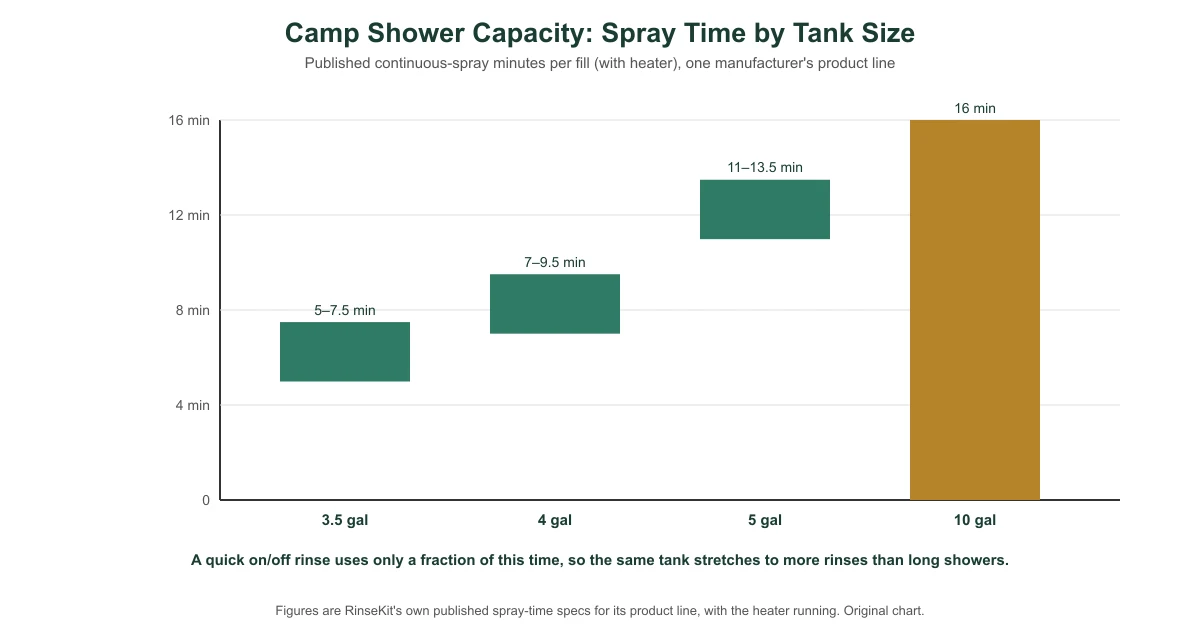
RinseKit’s own published specs give continuous spray time per fill, with the heater running, across its tank sizes: about 5-7.5 minutes for its 3.5-gallon PRO, 7-9.5 minutes for its 4-gallon Cube, 11-13.5 minutes for its 5-gallon Rack Shower, and about 16 minutes at a center flow setting for its 10-gallon Tailgate unit. These are continuous-spray minutes, not a “number of showers,” and they come from one specific product line, not a universal physical constant for all 5-gallon tanks.
To turn minutes into an actual shower count, you need to decide how long you expect to run the water per rinse, since that’s the step every “X showers” marketing claim skips over. A Navy-style rinse — water on briefly to wet down, off while lathering, on again briefly to rinse off — might use only a minute or so of actual spray time. A longer, more relaxed shower where the water runs continuously could easily use three to four minutes or more. Applying both estimates to the published spray-time ranges above shows roughly how far the same tank can stretch depending on habits, without treating either number as an exact count.
Capacity table: tank size by shower style
| Tank size | Published spray time per fill | Source | Rough quick-rinse estimate (~1 min each) | Rough full-rinse estimate (~3-4 min each) |
|---|---|---|---|---|
| 3.5 gal | 5-7.5 min | RinseKit PRO spec | ~5-7 rinses | ~1-2 rinses |
| 4 gal | 7-9.5 min | RinseKit Cube spec | ~7-9 rinses | ~2 rinses |
| 5 gal | 11-13.5 min | RinseKit Rack Shower spec | ~11-13 rinses | ~3 rinses |
| 5 gal (different brand) | Not disclosed | Stansport’s own marketing claim | States “3-4 showers” per fill; method behind this number isn’t published | |
| 10 gal | 16 min (center setting) | RinseKit Tailgate spec | ~16 rinses | ~4-5 rinses |
The “rough rinse” columns are this article’s own illustrative estimate, built by applying an assumed rinse length to the manufacturer’s published spray-time range — they are not manufacturer-stated shower counts, and your own results will vary with nozzle flow, water pressure, and how quickly you shut the water off.
How does this compare to a regular home shower?
The EPA’s WaterSense program states that a standard home showerhead flows at 2.5 gallons per minute, while a WaterSense-labeled low-flow showerhead is capped at no more than 2.0 gallons per minute. At that rate, a 5-gallon tank would empty in about two minutes through a standard home showerhead. The fact that a camp shower’s published spray times run well past that on the same tank size shows that camp shower nozzles flow at a noticeably lower rate than a home showerhead — though no authoritative source states the exact gallons-per-minute figure for a typical camp shower nozzle, so that comparison is directional, not an exact ratio.
How do you pick a tank size for your trip?

Start with how many quick rinses your group realistically needs before you can refill, then check that number against the table above rather than trusting any single “X showers” marketing line. A solo camper using the on/off technique can often stretch even a small 3.5-gallon tank across a full weekend, while a family sharing one 5-gallon tank for full, lingering showers will empty it much faster. For the full math broken out by trip length and group size, see how much water you need for showers when camping.
If your tank is smaller than your group needs, the biggest lever you have is technique, not a bigger tank. See how to conserve water using a portable camp shower for the full on/off method. For the rest of the setup process around filling, hanging, and draining the unit, see how to set up a portable camping shower, step by step.
Frequently asked questions
Is the Stansport “3-4 showers” claim reliable?
It’s a real claim from the manufacturer for its own product, but it isn’t an independently verified measurement, and the company doesn’t publish the rinse length or flow rate it assumed to get that number. Use it as one data point, not a guarantee.
Do bigger camp shower tanks always mean more showers?
Generally yes in terms of total spray time, but the actual number of rinses you get depends just as much on how long each rinse runs. A disciplined quick-rinse routine on a smaller tank can outlast a careless long-shower routine on a bigger one.
Why do camp showers get more rinses per gallon than a home shower?
Camp shower nozzles flow at a noticeably lower rate than a standard home showerhead’s published 2.5 gallons per minute, based on how much longer the published spray times run on similarly sized tanks. No source states the exact flow rate for camp shower nozzles, so this comparison is a general pattern, not an exact figure.
Does water temperature affect how many showers I get from a tank?
Not directly in terms of volume, but a heated unit draws down differently than an unheated one if any water is used to run the heating cycle. The published RinseKit spray times in this article already include the heater running, so they reflect real-world use with heat on.
Should I just buy the biggest tank I can carry?
Not necessarily. A bigger tank means more weight and more water to haul in and filter if you’re filling from a natural source. Match the tank to your group size and trip length using the planning table linked above, rather than assuming bigger is always better.
Sources
- Stansport, Jumbo Camper’s Solar Heated Shower product page — manufacturer’s own “3 to 4 showers” claim for its 5-gallon product.
- RinseKit, Frequently Asked Questions — manufacturer’s own published spray-time-per-fill specs across its tank sizes.
- Advanced Elements 5 Gallon Summer Shower, product listing — manufacturer-supplied capacity and weight specs for a different 5-gallon shower.
- EPA WaterSense, Showerheads — standard and WaterSense-labeled showerhead flow rates used for comparison.
portablecampingshower.com Editorial Team. Last updated: November 13, 2026.
Leave a Reply